The WE in WEdnesday moves to New York, and I write about it on a Sunday during a very long travel delay.
After a decade of watching Climate Week NYC from Philadelphia and further afar, this year I got motivated to go.I find it’s easy to be skeptical about festival-conferences, and probably at least a little bit right. While fragile sea- and landscapes once public are handed over to tech (despite rafts of lawsuits) and public school buildings are too hot to stay open, having a big get-together can feel fatuous, or worse, especially with CW events sponsored by emitters’ apologists and fossil gas enthusiasts. But there’s no “outside” a planetary climate crisi; as Alexis Shotwell memorably teaches, “contamination and compromise might be a starting point for doing something, instead of a reason to give up.”
I also got an invitation to speak at a roundtable, a student invited me to an ambitious workshop he was organizing, and other long-term collaborators told me about all the cool stuff they were planning to do . There was obviously a “WE” in Climate Week, and I realized I should show up for “my” people. Read on for a virtual visit to the events my “WE” organized in NY this year. My spotlight locates three I really appreciated, and I try to distill what was so helpful.
To Fight LNG work with locals, and youth
If you’ve read earlier essays in this series about the project My Climate Story, you know I’m teaching a new class this term on climate storytelling. We get to host fantastic guests experts, and I’m rapidly discovering that the students are experts too. (What a community we’re becoming–but more about that in a future essay in this series.) Keanu Arpels-Josiah is one of them, a leader in the youth climate justice movement. Keanu’s got some support from his college (coincidentally also my alma mater) to research how “place-based local work can build cultures of solidarity and cross-issue campaigns, ultimately investigating new movement identities and translocal strategies for youth movement spaces.”
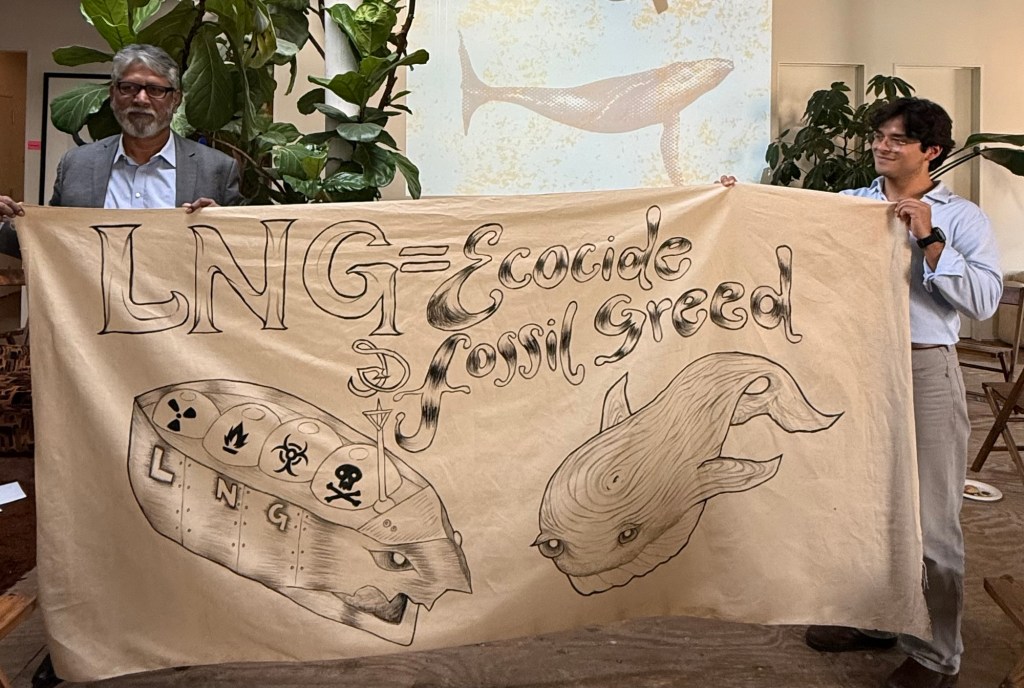
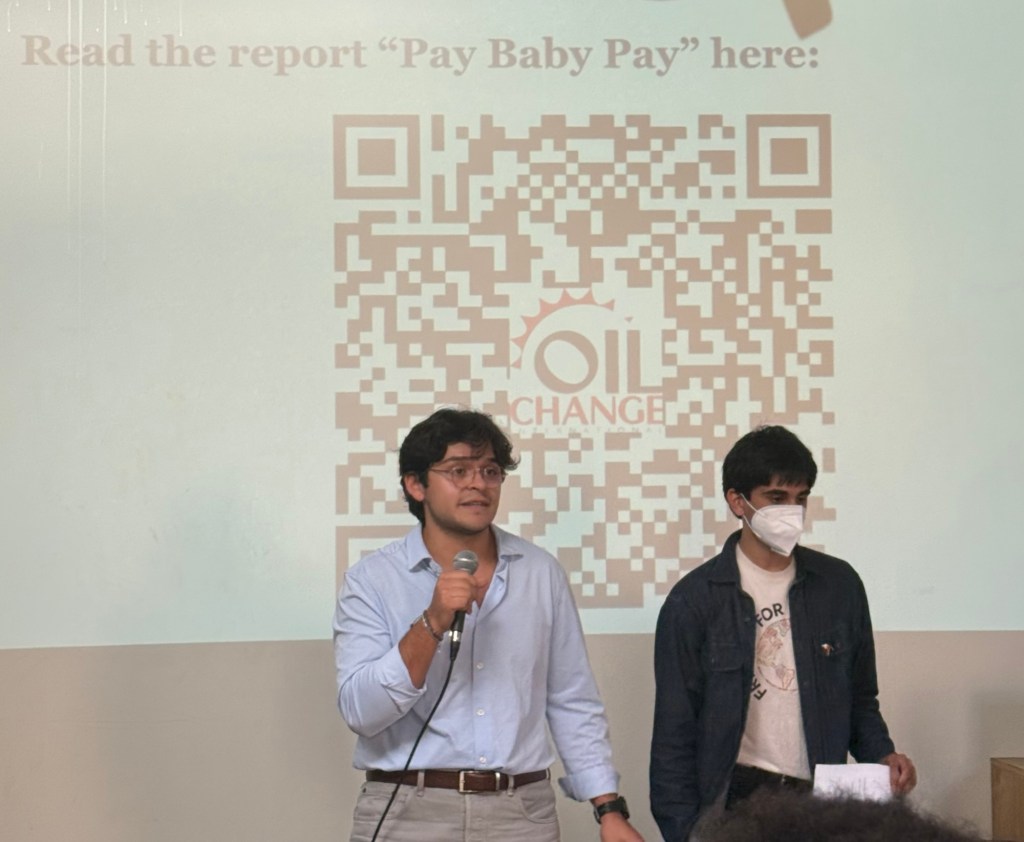
Pictured here: Organizers + participants at CW NYC event, “Fight LNG,” from (l-r) Bangladesh, Mexico, and NY. The voracity of the LNG ship on the left is apt (and appropriately apt). Click on the image at right to read the summer 2026 report “Pay Baby Pay,” by Oil Change International. Photos: Bethany Wiggin.
At CW, Keanu and Fight LNG’s José Reyeros (middle above) co-organized a learn-a-thon connecting researchers and activists all opposing the buildout of fossil gas infrastructure and traveling to NYC to share their knowledge from locations including Alaska, Bangladesh, British Columbia, Louisiana, Mexico, New York, Texas, Ukraine. I learned a ton from them all.
An aside: Two years ago, I published a book chapter called “Against LNG;” next summer, I’ll return to the topic as it intersects with ambitious electrification plans, including the 35 by 35 plan announced this week by the organizers of COP31 in conjunction with the meeting of the UN’s GA, also in NYC this week. (For incisive reporting on electrification as a solution in the wake of overshoot, albeit in German, check out this week’s edition of Der Spiegel‘s climate newsletter.) My new work on this project is taking the form of a multi-sited project tentatively called “The Electric Atlantic.”
Anyway, here are my 3 key takeaways from Keanu and Jose’s workshop, with a few links:
- Fossil violence is becoming increasingly visible and fast. Examples: US war in Iran and Russian war in Ukraine. Ivan (whose last name I didn’t get) foregrounded Ukrainians’ need to electrify as a strategy to fight Russian aggression but also worried about whether LNG imports from US would substitute, with LNG possibly to be brought on land in Croatia, re-gasified and piped. Allie Rosenbluth of Oil Change International sketched some of the complexities of LNG expansion against the background of the ongoing war against Iran during which, inter alia, Qatari production gas facilities have been bombed into oblivion, making the prophesied LNG glut non-existent and sparking an even faster race to facility development in the US + Canada. Allie sketched some positive developments coming out of the ashes: in the wake of the highly visible violence that is fossil resource development, Thailand has announced a shift in its energy policy from LNG to renewables; and Europe and others seem to be speeding up renewable development too.
- Locals have won historic fights against fossil majors. Wins can happen again. I learned a lot from local wins and strategies discussed by Kim Fraczek of Sane Energy Project, from Roishetta Ozane of the Vessel Project, from Sharif Jamil of Waterkeepers Bangladesh (pictured holding banner at left). Sharif powerfully connected fossil violence to human and more than human communities in the rivers and sea- and landscapes that gas export and import facilities destroy, pointing to interwoven histories and lifeways of fish and fishers, a thread also spun out by organizers in Alaska and British Columbia.
- “Youth” activists are smarter than (many) old-timers. This is a tru-ism and maybe trite, but it’s a good reminder, for me and maybe for you that the very least we old-timers can do is to show up for them and support.
Funding Streams for Literacy and Climate Need to Intersect
I zipped back to Philadelphia, also so I could teach my climate storytelling class where we hosted Jessica Seddon from TIAL. (More in a future essay on Jessica’s work on tipping points and changing the climate story as well as the roundtable she organized and facilitated). Then I Amtracked back to NY for a fascinating panel, “Delivering Climate Education,” co-organized by UNESCO’s Office of Climate Education and the Siemens Foundation. Moderator Dijan Sadadou (OCE) posed probing questions.
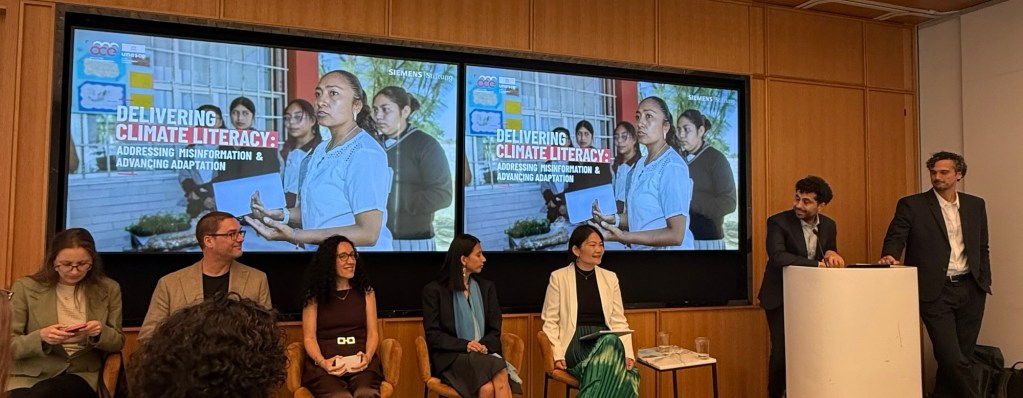
Pictured here: Panelists and facilitators of “Delivering Climate Education. Standing at the podium are Dijan Sadadou (Office of Climate Education, UNESCO, and Badin Borde, Siemens Foundation.) Photo: Bethany Wiggin.
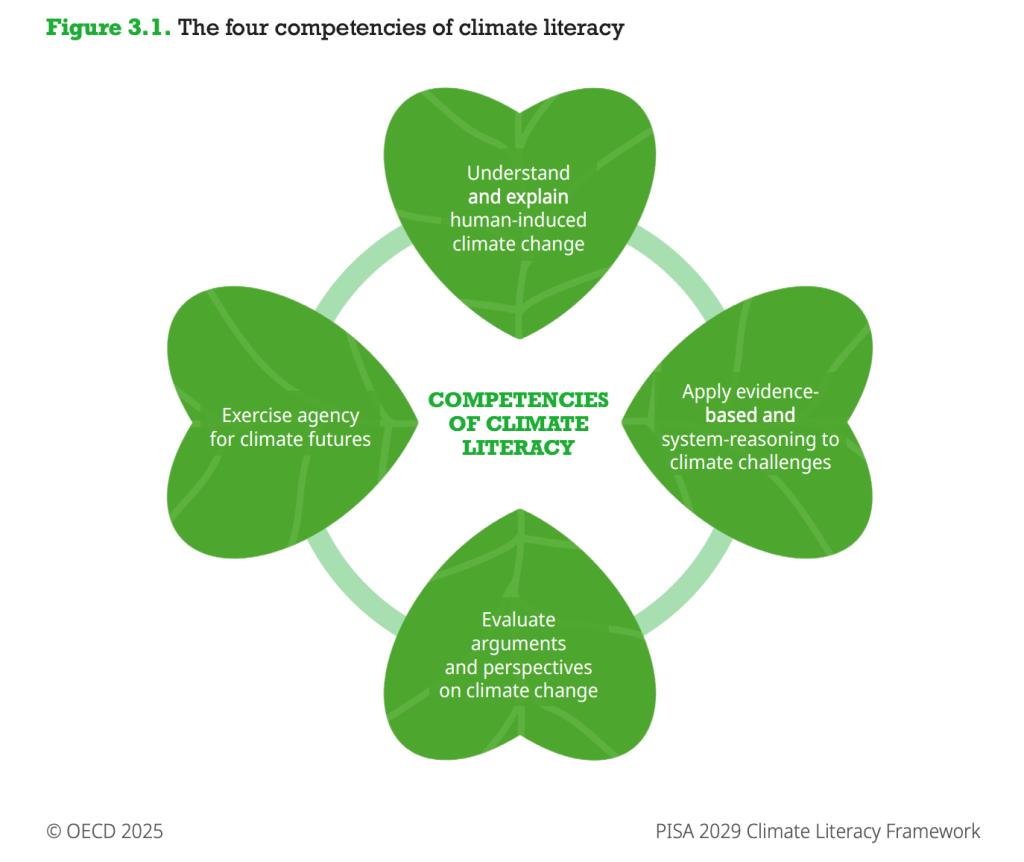
- Climate literacy requires creating shared language and a “we.” The OECD’s Pisa 2029 Climate Literacy Framework is impactful and can be more so. I refer it all the time, especially its visual (at left) illustrating climate competencies.
- Youth can be powerful climate educators and pro-environmental actors (see above!)–especially when their contributions are *not* tokenized. Youth should be involved in co-creative solutions at every stage from identifying the problem to formulating policy solutions and windows of opportunity, to education in and with community and in education in and with policymakers.
- Philanthropies dangle attractive carrots. To “deliver climate education,” as this roundtable proposed, philanthropies working in climate and education need to intersect in more places and more intentionally . As Siemens Foundation’s Badin Borde noted, this intersection is what enables change. Grant makers can learn from funders working on the right: redefine success so as to build the durable structures that allow for “creative collective networks of leadership.”
Climate creativity is where it’s at–and knows how to put a couch to good use
The final in-person activities I could squeeze in were mercifully and wonderfully all in the same place: The Creative Climate Forum, organized by the Human Impacts Institute at Pier 57. I visited the forum partly to check out the workshop on “Climate Storytelling in the Age of Disinformation,” by Tory Stephens (Grist) and Amy Westervelt (Critical Frequency/Drilled) who I took a picture of (scroll down, it’s a bad pic, sorry!) as they led a game of 2 true stories and a fake (fun! thank you!). I also visited the forum to see others’ climate storytelling projects. I saw a lot of good stuff 🙂 Scroll down to see some pics as well as the one of Amy and Troy which I took just after I thanked Amy for her pods on fossil money in American higher education and in school–a series that kind of got me through pandemic lockdown
I was really tired when I showed up at Pier 57. Sore feet might account a little bit for how much I appreciated Grey Area’s Living Room. It had couches. I needed to sit. It turned out, I also needed to talk!
If you can believe it, there were THREE climate therapists there. Uncanny.
Dr. Laura Carter Robinson talked with me about climate grief and sadness–and how to manage them while teaching. (She has a new book coming soon, Humanity and Planet, based on my talk with her, I think it’s going to be super helpful.) Leslie Davenport was sitting on the couch too, and I tried an exercise drawn from her new book, Climate Anxiety. Together, they are “The Climate Therapists,” and I was SO glad they were in.
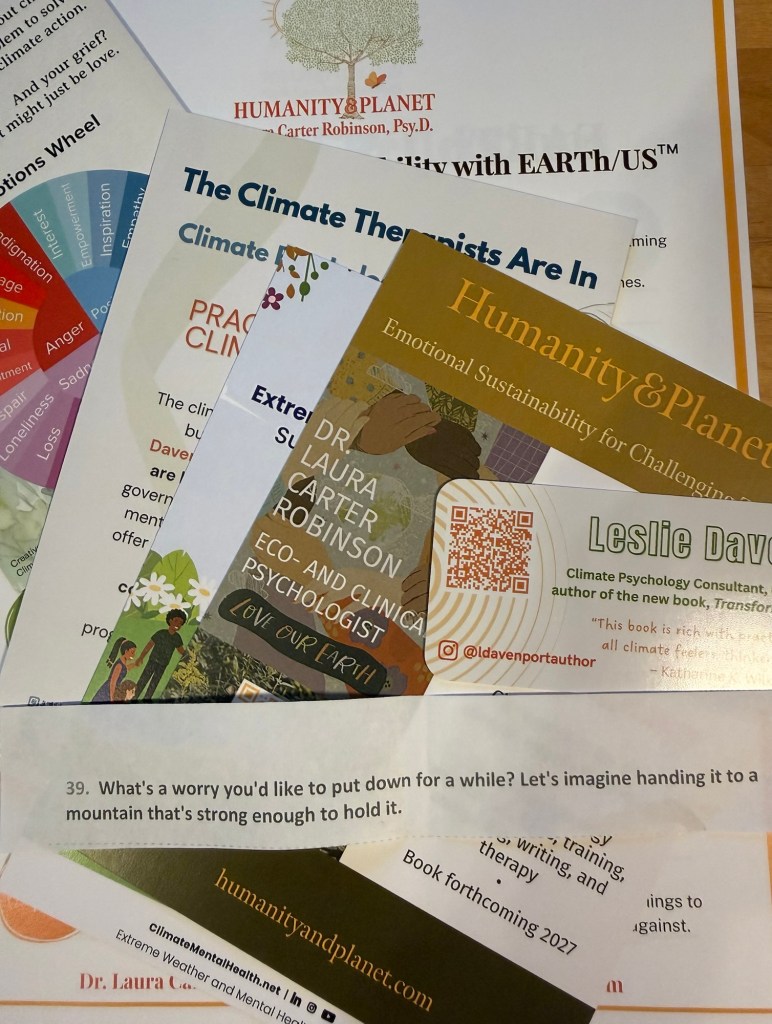
Leslie also writes for Grist, and she waved Tory down, and we all talked together. I was so immersed in the conversation that I didn’t take any pictures, not even a bad one. Instead I made this collage of the postcards and visuals the Climate Therapists had left in The Living Room. Our conversation offers a testimony to the power of design and the need for in-between spaces
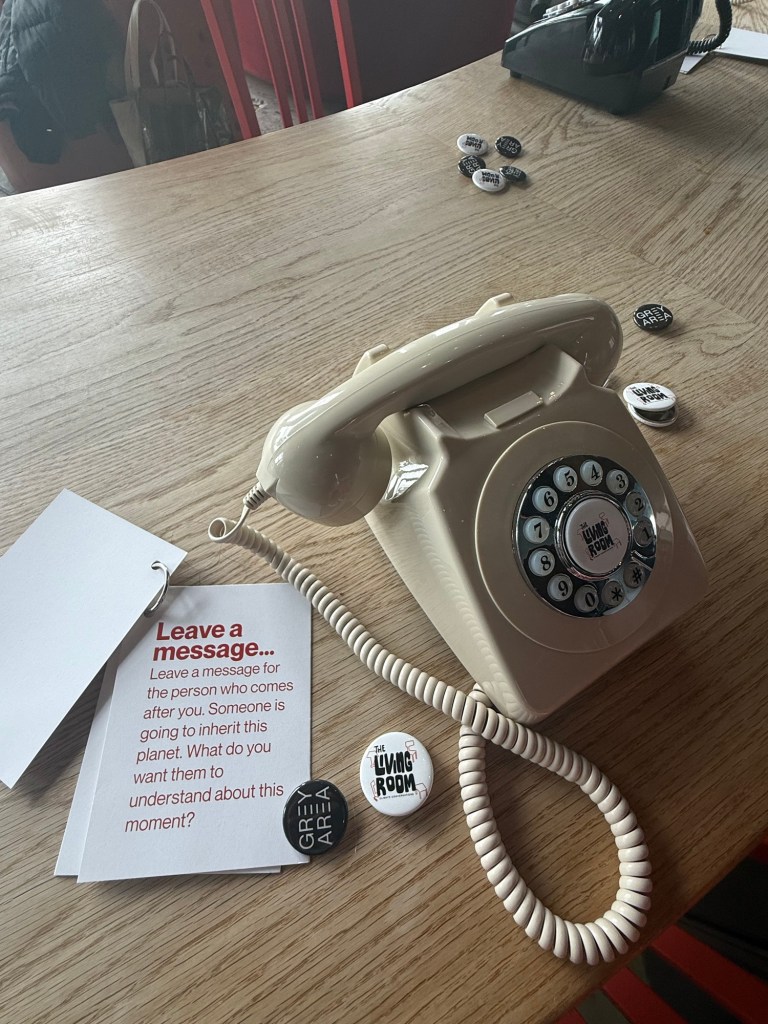
Below you can find some glimpses into The Living Room and their ideas about “Designing the In-Between.” I also loved the heft of the rotary phones they left on living room tables for visitors to leave a message. The big inflatable globe by the Dear Tomorrow team was fantastic, noth ethereal and weighty. I’ve said words make worlds way too many times, so you know I especially love this take. People’s words make up the world here, printed in various sizes and pieced together from scraps of notes. Here, Dear Tomorrow also gives the planet words to hail us: “The clock ticks. Vote.” I was so glad to cross paths with their creators and designers. So much to talk about. We just need more spaces in between, and couches, ideally with insightful climate therapists and educators already there.
Creative Climate Forum Hot Spots. Photos: Bethany Wiggin