This essay is a lightly edited version of the Bromery Seminar I gave at the Department of Earth & Planetary Sciences at Johns Hopkins University on April 18th, 2024. That seminar’s second part, on place-based environmental humanities work in Philadelphia, has been cut from this essay. It drew on a longer essay on that topic that you can read in its entirety, “Archive, River, Museum, Street.”

“I don’t want you to listen to me, I want you to listen to the scientists, and I want you to unite behind the science.”
A gust of fresh air, Greta’s famous 2019 appeal swept into the halls of Congress and added wind to the sails of amazing youth activists, many from Black and brown communities (including those behind her in this still from the New York Times‘s video of her address). Thirty odd years after Jim Hansen sat in the same seat, many (me included) hoped and maybe even believed that a new era of joint partisan political will to act on climate might finally have arrived. Five years after Greta’s appearance, it’s harder than ever to remain sanguine about our current course.
Among hosts of discouraging news, CO2 levels trend resolutely up, moving north faster than ever. It’s certainly not Greta’s fault that we are where we are.
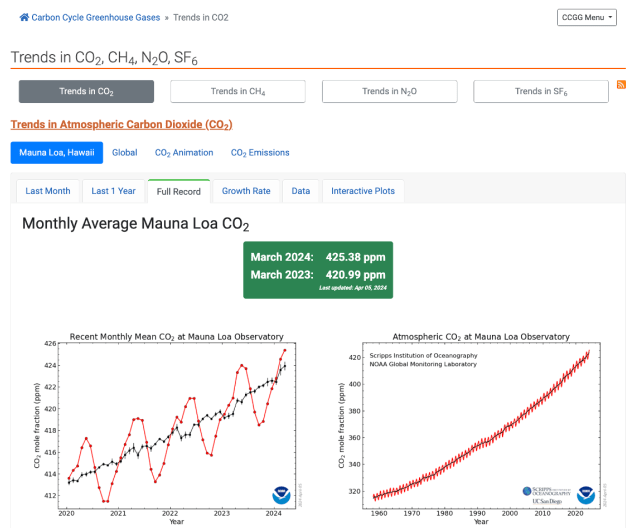
But today, I want to talk with you about why I think Greta got it only half right, and I want to talk with you about collaborations across the environmental arts and sciences that can, I believe, transform the ways we understand and address environmental problems and solutions. Science must inform all policy. But science of course (and I don’t need to tell you, planetary scientists at Hopkins!), well, science does not prescribe what to do with scientific findings. While we certainly need to listen to scientists, we can’t expect you, on top of all you’re already doing, to tell us how we should act in light of your work.
So I am an environmental humanist, a somewhat strange term that I’ll come back to in just a moment. I am also a firm believer in the importance of the liberal arts to democracy and democratic decision-making–all the liberal arts, in the classical meaning of both the “free” (or non-applied) arts and sciences. And while I think I probably sound hypocritical saying it since I teach at a private university not entirely unlike Hopkins (but with a worse lacrosse team), I am also a great believer in public education, and I hold research to be a fundamental human right. Perhaps I should say I am an environmental humanist and a public humanist.
In the next 30-ish minutes: I want to talk with you about what Environmental Humanities is or could be, and I want to show you a few projects I’ve had a hand in as the director of Penn’s experimental EH program. It’s exciting to me that this science department invited me to speak with you, and I hope you’ll see why I think listening and talking with one another holds such promise.
My remarks are in four parts, and I’ll try to signpost them for you. For the first, I’ve prepared more formal, written remarks, as we humanists habitually do. But fear not, the remaining parts feature the voices of participants in three collaborative EH projects and include lots of pictures and a few video clips.
- The first, a place-based project in Philadelphia with residents of a neighborhood next to the former Philadelphia refinery [this section has been omitted from this post since it condenses the longer essay available in its entirety, “Archive, River, Museum, Street”]
- The second, a working group that draws together ten place-based campus-community partnerships to test methods to amplify community concerns amidst energy transitions
- And the last, a climate storytelling and story sharing collective that I started with students amidst pandemic and which is now working, on a small scale, across twelve North American campuses
All three of these projects bear on connections between education and the project of democracy, the final most directly as it advocates for more robust climate education both in and beyond formal classrooms in the face of persistent and influential climate misinformation campaigns. As public health experts and anti-tobacco campaigners know, public education works. Since 1992, the UN’s Framework Convention on Climate Change has recognized climate education as a key climate solution. Thirty plus years after that Rio summit, climate and environmental education still remain unknown to many students (and teachers). We have to stop educating our students as if we still inhabit a world that no longer exists–one in which nature and culture can be neatly divided. Environmental humanists and scientists need to continue talking together.
First, what is EH?
The phrase does not roll off the tongue, and, as some of its earliest users have told me, its weirdness was the point: they coined it in part to unsettle expectations about the disciplinary domain of the environment. We assume that the environment is explored through science–as did the organizers of an event at Lincoln Center organized by my home university to feature my work 😉
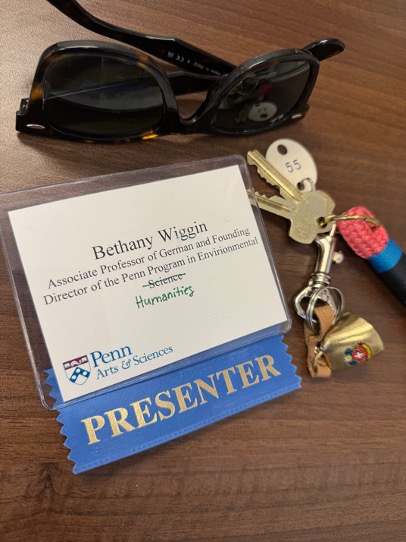
But of course the environment has a history: as an analytic concept and as histories of myriad environments. The environment has also been described or engaged with by literature, the arts and music; and religious and ethical systems all profoundly shape how we see, understand, and remake the human and multispecies worlds we inhabit, profoundly impacting earth systems as we go.
Over the past fifteen or so years, the term environmental humanities has grown tremendously in popularity as conferences, journals, programs and courses of study proliferate across the global North and South (see a recent Swiss take here). It’s arisen in close proximity with related terms, for example, sustainability sciences and sustainability studies. At their best, all of these terms signal the need for collaborations across disciplines, and they effectively enable interdisciplinary work that so often leads to the kinds of community relevant and even community responsive work that emerges from their shared concern with place-based inquiry. At its worst, the term environmental humanities alienates scientists and provides a rhetorical mask behind which humanists produce much the same outputs they’ve made since the 1970s..
A few months ago, as colleagues across disciplines at Stanford planned their new course of study in environmental humanities, they asked me to answer a bunch of questions, including one which more traditionally-trained humanists (including me) often raise: “Can Environmental Humanities exist without Humanities?” Or Can EH exist with H? In the ensuing three months, I’ve continued to think about this question, born in part from the reduction of tenure lines in humanities departments since 2008 and, precipitously, since Covid-19. The irony is cruel, since EH was implemented in many humanities departments in part to counteract sustainability studies’ focus on techno-scientific, short-term solutions to environmental problems long in the making. How did EH practitioners propose to do that? by opening environmental problems to broader inquiry about their making and management–and to invite more creative, even imaginative responses to solving them, drawing inspiration from diverse cultural and historical traditions grounded in local and indigenous ways of knowing and living. Traditional humanistic skills include, among others, “the ability to engage in ethical and moral reasoning, the capacity to analyze texts and critique them, [and] the patience to pause and sit with ambiguity” (Ximena Briceo). Surely we need more of these skills, before we rush to solutions that may actually exacerbate underlying problems. So no, I don’t think EH can exist without the H.
And yet there is no doubt that EH transforms the humanities. But I think the issues that EH is responding to are just as much issues for you scientists. For me, to apprehend the mesh of nature and culture that we inhabit, I can’t only look at culture: literature, film, and music. For you scientists, I’m guessing you see too well how the material world is enmeshed with human culture, from plastic gyres and other less grotesque anthropogenic landscapes to hurricanes and fire seasons fueled by humans’ carbon habit. You know better than I how these realities are changing your own work and perhaps changing how you train your graduate students and even your undergraduate teaching. I hope we get to talk about that in the q and a. I can share anecdotes with you about biology PhD students who take my seminars to learn about grief and mourning and Environmental Studies Masters students who enroll to learn how to make place-based work that is responsive and responsible to community needs and desires. But training advanced students in EH only dimly resembles the training I got as a more conventionally trained humanist.
To make good work in EH, I’ve had to learn a lot of new skills:
- Listening carefully to academic collaborators in other fields
- Listening to community members and devising community-accessible participatory research methods
- Making project outputs that don’t look anything like the articles or books I was trained to write
Let me now turn to the EH projects I want to show you. And let me be candid: I hope you might spot ways that you–and scientists like you–could get involved and expand this work. So maybe let’s talk about that too in the q and a. For each of these projects, we’ve cultivated (and maintained) transdisciplinary campus-community partnerships, and together we have made (and are making) community-responsive research. In ways both big and small, it has transformed those involved.
Building Place-Based In Philadelphia
Read the full essay on place-based project, “Archive, River, Museum, Street,” that this section of my seminar was based on; for reasons of time, I have not posted it again here.
Scaling Place-Based Methods: Campus-Community Collaborations to Amplify Community Voices Amidst Energy Transitions
Intersecting Energy Cultures
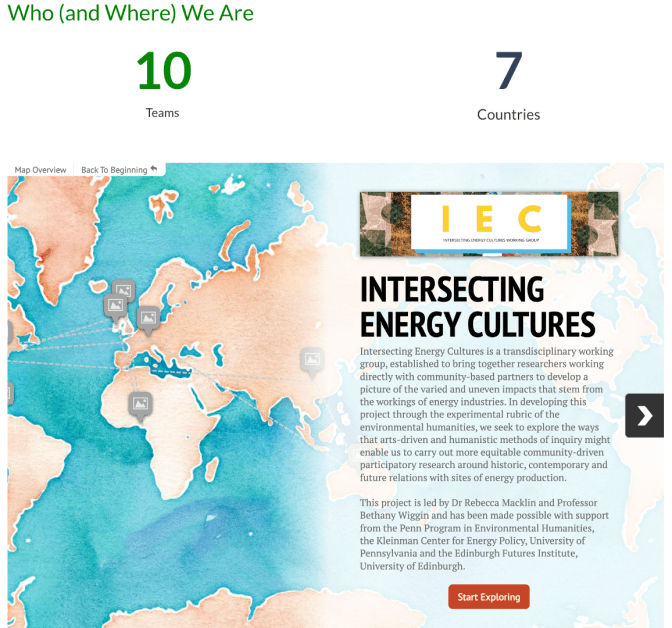
The next project I’ll show you grew directly out of our work to create archives and bring them out onto the street of Philadelphia with the Futures Beyond Refining project. It’s called Intersecting Energy Cultures. and with my Co-PI, Dr. Rebecca Macklin of the University of Aberdeen, we’ve set out to test a variety of community-based participatory methods designed to amplify community concerns in historically energy intensive landscapes. In the summer of 2022, Dr. Macklin and I circulated a call for teams to create a global working group devoted to “Intersecting Energy Cultures,” now made up of ten teams working across diverse energy systems and conducting local workshops on energy histories and futures, employing a variety of community-based research methods: community archiving, interviewing, and a range of storytelling practice, including tours and, as you will soon hear, one full-blown outdoor theatrical performance.
Our primary aim has been to connect academic researchers working directly with community-based partners to develop a picture of the varied and uneven impacts that stem from the international workings of energy industries. By considering how historic energy forms often intersect, we’re paying attention to how communities are all too frequently caught amidst multiple and overlapping forms of energy production which amplify existing vulnerabilities. New energy regimes are often not quite so “new,” as they literally build upon existing infrastructures and legal frameworks, even in the face of considerable community pushback.
We have chosen to carry out these experiments under the experimental rubric of the environmental humanities because we believe that the arts and humanities offer valuable methods of engagement for participatory work and welcoming avenues for the co-production of knowledge with communities.
As this pilot phase of our work draws to a close, we are making a series of documentary shorts about the work each team has been carrying out. Intended to be viewed as stand-alone short films as well as as an ensemble, the shorts are one important project outcome, alongside a planned special journal issue and set of policy briefs.
Over the last five months, Dr Macklin and I have completed all the preparatory and formal interviews in the teams and written the scripts. In just a moment, I’ll show you two clips from the radio edits for two of the teams. Since these are radio edits, I want to encourage you to close your eyes while I screen them. Soon, our film producers, Megan Pollin Hernandez and Tom Quigley, will layer over the many visual materials each team in the WG has been gathering. [Please check back in the coming weeks for the final versions of these films, expected by June 2024.]
This first clip is of the team based in and around Cochocton, Ohio, home of a demolished coal-fired plant, with campus partners from The Ohio State University and community partners at the Pomerene Center for the Arts in Coshocton. You’ll first hear from Jeffrey Jacquet, a sociologist, whose field interviews in coal country and coal-fired plants fed collaborations with theatre professor Tom Dugdale and scriptwriter, Anne Cornell, the Artistic Director of Pomerene.
The second radio edit I’ll show you features Lawrence Ogbo Ugwuanyi, a philosopher and professor at the University of Abuja in Nigeria who, together with Igbo community organizer O.F. Uche are exploring the ethics and practice of communalism in a region of Nigeria which, like the Niger Delta, is a producer of oil and gas, but, unlike the Niger Delta, is relatively understudied. Scientists who have visited previously and spoken with community members have never returned, as Lawrence explains in the film
Humanities in Climate Classrooms
Exploring the Personal and Emotional Impact of Climate Change
My Climate Story
My Climate Story is a public research project to document and share personal, local experiences of global climate change. It includes a freely available curriculum, a series of participatory workshops, a short documentary, a growing set of teacher and student resources, and a Story Bank where hundreds of storytellers have shared their personal narratives of climate change that get tagged with light metadata to make them searchable by location, climate impact, and the authors’ feelings. Most share that they are “worried,” “sad,” and “anxious,” and they also tell us that sharing their story helps them to feel less alone and empowered to take climate action. As we tell project participants: Climate Stories can illuminate and explore the impact of changing climates on people’s everyday lives. Climate stories make climate data meaningful–and actionable!
The project was, improbably, born during pandemic, and despite the inauspicious circumstances, it thrived. (To this day, I have never met in person the undergraduate students with whom I worked to develop online workshops, write a workbook and a documentary script.)
I’m guessing you’re asking what a “climate story” is. As we tell project participants, a climate story:
- Shares an individual experience sensing climate change
- Is anchored to a specific, personally meaningful place
- Invites the storyteller to include more than just data: emotions, reflections, memories
Why does the project insist participants TALK about climate change?
Conversations of course provide the building blocks of culture, they are cultural tools, and they illuminate the ties between the personal and the political, or between private life and political economy. When we consider climate conversations as cultural tools and when we consider our failure to create and use those tools, we begin to understand climate denial differently from the way it’s more often understood here in the U.S.
Exploring such everyday strategies–of not talking about climate in polite society, for example–helps us understand climate “denial as socially organized rather than as merely an individual phenomenon” (Norgaard 134) or even only as a result of misinformation (although it is also that). Climate stories–or their lack–help us understand how holding climate information at a distance is one strategy by which a “non-response to climate change” can be “produced through the cultural practices of everyday life,” as sociologist Kari Norgaard writes about. Studying climate stories helps us understand our obstinance to changing in the face of the changing climate as “social drama” (Philip Smith and Nicholas Howe). Climate inaction emerges is not so much a result of an information deficit, i.e., that if only we had more science or if only people listened to the science, we would act on climate. Instead, to tackle the “psychic numbing” (Robert Jay Lifton) that climate change can provoke, we need to offer conversational tools. Listen to the humanists.
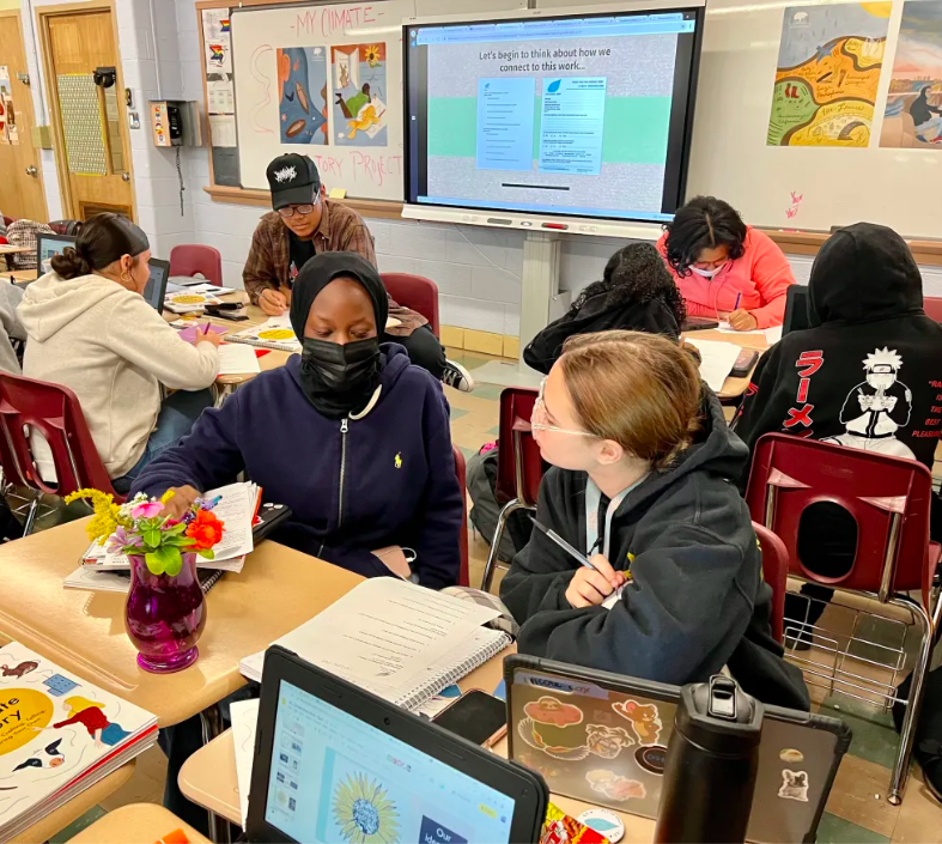
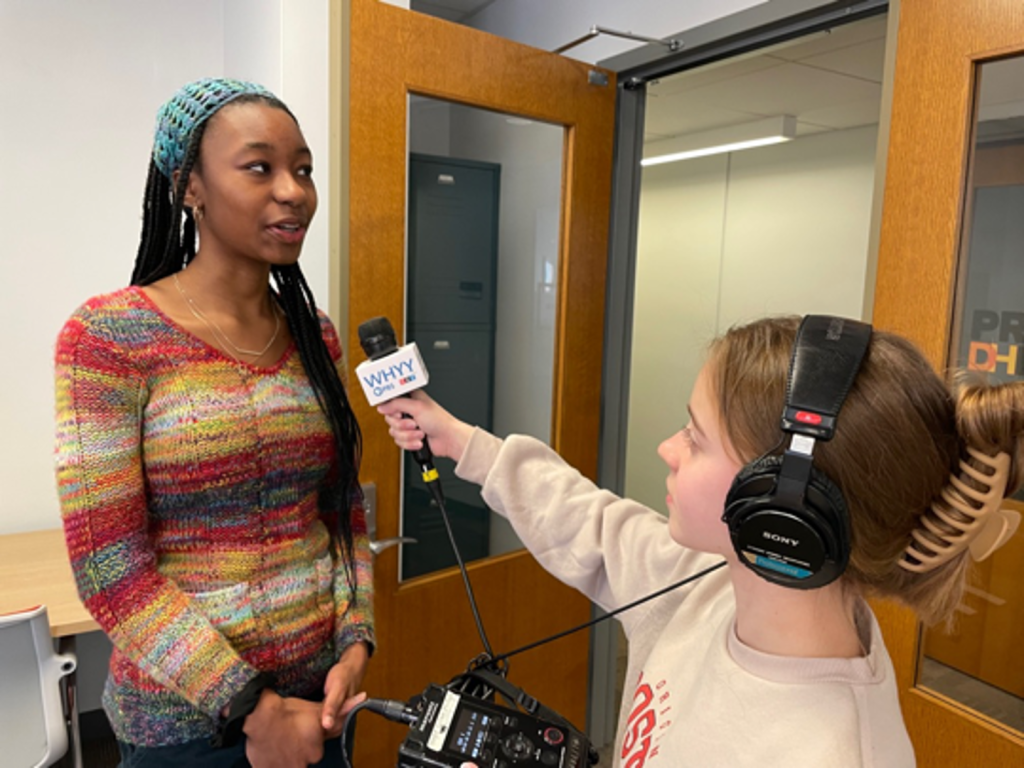

As we moved out of pandemic, we began to test our modest curriculum in Philadelphia high schools, and last year we supported nine high school classrooms across our city to pilot our workbooks and to create additional curricular resources and offered workshops in partnership with news radio WHYY, a NPR-affiliate.
This year, my students are training Campus Correspondents around North America. Let me share their voices, in an excerpt from the short film we made about student Maria Villareal Simon’s leadership of that initiative. The excerpt is embedded below. (Or watch the entire 5-minute short.)
Last Friday, we offered an op-ed writing workshop, a capstone of sorts for their work with us. I’ve been editing their essays all week, and teaching them to pitch.
On Monday, we spent nearly 5 hours with WHYY who will feature these youth voices in their Earth Day coverage.
[After this talk was delivered, Philadelphia’s NPR affiliate, WHYY, aired another story about My Climate Story and published a longer online story.]
CONCLUSIONS:
So what does this all mean?
In working on these projects, we have learned many things:
Collaboration is messy and it takes a lot of time. It is also almost always worthwhile. In my own case, moving out of my disciplinary comfort zone has estranged a lot of my assumptions about the world and helped me see things in far richer and more complicated ways. Students report they love these EH classes that often move them beyond traditional classrooms helping them transform the world into a space of learning, with classrooms in museums and on streets, rivers, parks, and even waste yards.
This kind of transformational teaching and learning takes time–it is not a silver bullet that will “end climate change” or magically undo the harm we humans have done to living systems. And yet is is these collaborations to encourage wider participation in remaking the world that offer me the most hope.
Together, we endeavor to see the worlds we’ve made in all their beautiful brokenness and to imagine them anew.