This talk explores several multi-year campus-community projects to explore how environmental humanists can and perhaps should work in worlds beyond the classroom, conference, journal, and monograph. The talk opens a number of thorny questions: what skills, beyond critical skills, does it demand? What is the temporality of such work in the world? How can it coincide with the rhythms of the academic year? What does it mean for peripatetic humanists to commit to care for communities on and around their college campuses? What are the ethics of such collaborations? Do they ensure mutual benefit?
Note: I gave this invited talk at Stanford University on January 12, 2024
On Tuesday, the lab at Mauna Loa measured atmospheric CO2 levels at 423.16 ppm. When I began my graduate training in German, French, and English literature almost three decades ago, the yearly average was 359 ppm, more than 60 ppm lower than today. James Hansen had testified to Congress about the dangers of atmospheric heating six years before I graduated from college in 1988. I had responded quixotically and tried to convince my high school to stop purchasing styrofoam and then in college joined the chapter of Earth First, pledging to reduce, reuse, recycle which primarily consisted of using a snazzy reusable plastic coffee cup.
Just a few years later, in 2000, Paul Crutzen made the epochal proposal that we are now living in an era that humans–with styrofoam, plastic, fast food and fashion, heaps of carbon, and more–have rendered geologically distinct from the holocene, and named it the Anthropocene. While this “age of man” concept has many well-known flaws, its twining of human history with natural history has nonetheless offered an important conceptual lever encouraging scrutiny of the nature – culture divide, of the formation of the “two cultures,” etc. The concept has also provided a prompt to devise paths of study aiming to marry the two. Environmental Humanities is one of those. Yet, we continue to train humanists as if we were still operating within safe planetary boundaries.
The most widely cited definition of EH, from the first issue of the journal EH, announces its aim to marry critique with action. With you today, I’d like to consider what that means in practice and reflect on what it is that EH acts on, how, and with whom. My remarks today also respond to three questions that Ximena Briceno shared with me just before Christmas:
- Can the Environmental Humanities exist without the Humanities?
- How must institutions adapt to EH?
- What constitutes a solid foundation for undergraduate education in EH?
These are critically important questions. I’d also like to add two more:
- Does EH entail making work whose scope exceeds the academy?
- What does this all mean for the way we train students and evaluate work?
My answers draw on the experience establishing EH at Penn and from a decade of intense dialogue with colleagues in the Americas, in Europe and Britain, Australia, and to a lesser extent in India, all working in EH or adjacent fields. In the final part of this talk, I’ll show a few collaborative EH experiments that I’ve been part of, experiments designed with the explicit aim of making the spaces and places of higher education more porous by providing contact zones both across disciplines as well as across learning communities both on campus and off.
Question 1. Can EH exist without H?
When I joined the faculty at Penn CO2 levels averaged 376 ppm. A general education curriculum had been implemented three years before I arrived as an assistant professor; it is the same gen ed curriculum Penn students follow today. During pandemic, I headed a committee struck by the Council on Undergraduate Education to evaluate the need for climate and eco-literacy in a liberal arts education and to make corresponding recommendations. Our final report emphasized: “One guiding principle informs all [the following specific recommendations]: Ecological and climate education should occur across the arts and sciences, drawing on the range of liberal arts to cultivate the capacity both to imagine and to realize a future not dominated” by the chaos and hardships ensuing from continued transgression of planetary boundaries.
In other words, I firmly believe that EH cannot exist without H.
I appreciate how Ximena framed the first question you sent to me: “In the interest of expediency, EH initiatives might withdraw from introducing traditional humanistic skills, such as the ability to engage in ethical and moral reasoning, the capacity to analyze texts and critique them, or the patience to pause and sit with ambiguity.”
To these vital humanistic skills, I’d also like to add the facility to apprehend the contingency of cultural, political, and technoscientific forms and structures as well as to imagine how they are constantly being made otherwise.
And this is where my answer to this question about the existence of the humanities in EH gets more complicated. For, even as the humanities have grown to include vastly more diverse objects for examination, often through creative interdisciplinary lenses, humanistic objects of inquiry remain, as Caroline Levine also argues, most often diminutive: the untranslatable concept, the luminous detail, the exceptional. (One notable exception is of course “distant reading” or what Moretti also called the study of “normal literature” and the sociology of literature more broadly.) But the humanist occupation with the small is not limited only to the space that humanistic objects take up, but as David Armitage and Jo Guldi have documented, it also is true of humanistic analytics of time. Working at the scale of a work or even a movement, style, or period limits apprehension of lives “in the wake” as Christina Sharpe has shown, and blinkers our view of the forms and structures that, over centuries, shape individual lives, preventing some from mattering.
Finding methods that allow work at the middle durée is a central concern of the book I’m working on now: Utopia Found and Lost. For me, that’s meant learning how to read forms and structures that exceed the textual, including rivers, creeks, and neighborhoods; and it’s meant learning narrative techniques beyond historic realism. I have learned a lot from environmental historians, historians of science, environmental anthropologists, and STS scholars, and I have slowly come to regard environmental case studies as modes of genre or formal criticism.
And following Zoe Todd and AM Kanngieser’s insights into case studies, I now try to make kin studies, not case studies. Entangled with the forms and structures of rivers and creeks as well as their textual representations, my work is ineluctably enmeshed in worlds beyond those more famliar to humanists: the campus classroom, the library, or the archive. In trying to understand their making, I cannot help but act on them and have become accountable to them, making kin in Todd’s words, making for sometimes uncomfortable relations. {A first version of this paper began with a long anecdote about my shock when a community partner told me she did not understand the point of my work.} I have chosen to embrace this accountability, making work also response-able to worlds beyond the academic, even as we hear that such work is not “research.”
This type of work in the world is necessarily collaborative: across disciplines and across learning communities. It is not easily supported in those academic structures which are often our tenure homes: the department.
With notable exception, such work is not supported by departmental structures, places where it often still looks like it’s 1990 (when atmospheric CO2 was at 354 ppm). And departments are grouped into divisions—natural sciences, social sciences, and humanities—that render interdisciplinary training hard. And of course they also reify the nature/culture split arguably at the origin of our Anthropocene woes.
This split is of course a problem as much for the natural sciences as it is for the humanities.
And, to turn back to our first question: I think it would be fair to say that much as EH cannot exist without H, environmental science cannot exist without the humanities either.
Nonetheless, amidst an academic economy of scarcity squeezing humanists like a giant squid, humanists understandably hesitate to cede established domain, fearing often correctly that lines, or even whole departments, will disappear. I have a lot of sympathy with this view, but I think the answer, painful as it might be, is to seek more, not less alliances with scientists, more not less collaboration, and more not less training of graduate students to find homes at the intersection of the arts and sciences. (I have only anecdotal evidence on this, but most environmental scientists I speak with wish for more collaboration with humanists, not less, especially if they are already tenured.)
Question 2.
So we’re already in the midst of the second question: “How must institutions adapt to EH?”
In short, my answer is that to apprehend and respond to Anthropocene challenges, we must create structures, including departments, that enable collaborative work and that encourage individual careers that can more easily traverse the arts and sciences. This will mean, in the near term, that tenure and promotion committees learn to work more adroitly across divisions and that future tenure homes exist to encourage the creation of expertise that undoes hallowed traditions that separate human and natural worlds. And this means we will also need to train our students differently to become those experts–and not just in the humanities but also in the sciences. We must encourage (insist?) that our science students also receive training in those very humanistic skills we talked about earlier, including especially I think ethics and, again quoting Ximena, “the patience to pause and sit with ambiguity.”
Question 3.
What constitutes a solid foundation for undergraduate education in EH?
At the undergraduate level, I think we need to ensure that all students graduate with an understanding of the ecological crisis which we inhabit—both how it’s been created and the solutions that exist and can still be found. It is foundational to apprehending and ethically inhabiting worlds, and we cannot continue to educate students as if CO2 levels are in the safe operating zone. (We left 350 ppm behind in the late 80s.)
To date, my Penn committee’s recommendations haven’t gotten too far—although they have ignited the will to overhaul the whole of the gen ed curriculum so I suppose that’s something. However, we do have a minor in EH, and I’d be happy to talk more about that with you. But it’s small—and it’s not bold enough to meet the challenge of educating the next generation of leaders capable of meeting the challenges they are facing. But it does a couple things that I am proud of.
Since 2016, EH at Penn has followed four guiding principles:
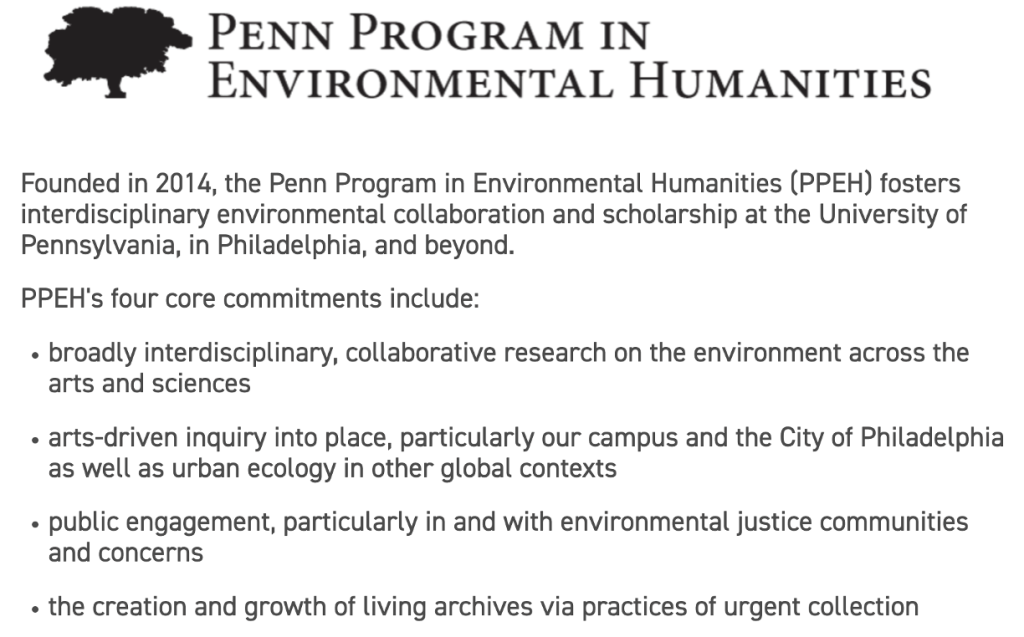
Premised on collaboration across “distant interdisciplinarity,” this vision of EH is atypical, and it has not been easy, for all the reasons I’ve just talked about.
We’ve been more successful with our commitment to publicly engaged research and teaching, the arenas where EH critique meets action. Along the way, I’ve had the opportunity to reflect at length about who I make work for and with and how to ensure that publicly engaged work benefits non-academic partners. I’ve also learned new skills, skills I now also teach my EH students:
- how to make a podcast
- how to script and produce short video documentaries
- how to testify in front of elected officials
- how to stop worrying that this work often won’t be counted as “work” in academic arenas
- how to listen
- how to be accountable to project partners, especially those who are less well resourced
- how to put my (grant) money where my mouth is
In the interest of time, instead of answering the last two questions of this talk directly, I thought I’d offer a super short view into the publicly engaged work itself, with two short clips from two related projects, both situated on and along the river that borders my campus’s eastern edge.
The first, about two minutes, is from a short documentary about the “On-Water Intensive,” a two-week field school for students from Penn and nearby Drexel and co-taught with environmental scientists from Drexel University. Together, we sought to shed light on all we didn’t know about the tidal Schuylkill River, a “forgotten place,” in the sense that Ruth Wilson Gilmore describes. You’ll hear undergrad, now alum, biology major Ana Alonso talk about the field school’s method for making response-able research. The other clip I’ll show you is from Futures Beyond Refining, a rapid response public engagement that began in 2019, one year after the On-Water Intensive, in the immediate aftermath of a catastrophic explosion of the Philadelphia oil refinery that so long dominated south Philadelphia.
So first, Clip 1.
In this next clip, you’ll hear research partner and community organizer Tammy Reeves explaining to tour participants what it’s been like to live next door to a refinery. This tour was part of a three-year project that started just before the first Covid lockdown. It began in an EH seminar at the graduate level in which students worked in partnership with Reeves’s community organization, RAC2, whose members and families have lived in the refinery’s neighborhood for generations. Together we created a modest oral history collection, workshops for eighth-grade science students, community-led tours, and a temporary memorial to lives lost to refining.
In the interest of time, I won’t talk to you about a project I’m really excited about and which I hope we might interest your undergrads—but please check out these postcards for more info about modestly paid internships we are now offering for work with My Climate Story.
By way of conclusion, I’d like to offer five short points about what a person might do (or not do!) to facilitate publicly engaged work. These are reflective of mistakes I’ve made and lessons learned often the hard way, and I have thus written them in the first person:
- Remember that when I’m working in community, I am, for better and worse, viewed as my institution. For example, even though I might not know anything about past disagreements between my wealthy university’s real estate division and the city’s scrappy parks commission, I might get blamed for my institution’s position.
- Remember that when I’m working in community, the academic calendar means very little. Collaboration is slow and does not wrap up according to an exam schedule. Remember to remind my students about this too and to design assignments accordingly.
- If I’m serious about collaborating with community partners, we must meet in spaces where my partners are comfortable. Those spaces might be on campus, but more often than not they’re not. Experiential and/or informal educators likely will get sick of a formal seminar-room setting. Collaborators with little formal education will not necessarily feel welcomed at my institution of “higher” learning. Meet people where they are and then also show up for them, helping out with projects that are important to them, not just for me, while also being clear from the outset about what I can deliver and what they might expect from me during our collaboration.
- Collaboration works when in pursuit of mutual goals. Take time to figure out candidly and iteratively what they are and can be. Listen more than talk. In my own case, very few of these shared goals has taken the form of an academic product. Know that and make sure you can commit to it.
- Compensate–in money or in kind–community partners for their roles in creating academic work.
The environmental humanities makes work in the world, in worlds of vast and sometimes beautiful differences. As CO2 levels continue to soar and we race through planetary boundaries, reducing, recycling and reusing are not enough–even though we equip our students to do just about that and no more. By acknowledging that our work is inevitably in and of the world, we can also get good at it.